Tycho’s strange death
It has long been thought that Tycho Brahe died of a complication to his bladder, when he did not let his urine from politeness at a dinner in Prage 1601, eleven days before his death.
However, more recent studies started 1996 from opening the grave of Tycho Brahe and analysing his hair, have showed that it is very likely that Tycho Brahe in fact died from Mercury poisoning.
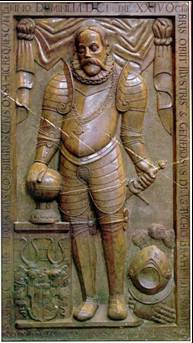
The tombstone in Prag where Tycho Brahe's remains rest today
When Tycho died, Kepler succeeded him as Imperial Mathematician. Tycho's observations of planetary positions, which were made using instruments with open sights (a telescope was not used for astronomy until about 1609), were much more accurate than any made by his predecessors. They allowed Kepler, who (unlike Tycho) was a convinced follower of Copernicus, to deduce his three laws of planetary motion (1609, 1619) and to construct astronomical tables, the Rudolphine Tables (Ulm, 1627), whose enduring accuracy did much to persuade astronomers of the correctness of the Copernican theory. However, until at least the mid-seventeenth century, Tycho's model of the planetary system was that favoured by most astronomers. It had the advantage of avoiding the problems introduced by ascribing motion to the Earth.